

 Curious about technical writing?
Not ready to spend money on training?
Good news. You can learn a lot for free.
Free courses, open textbooks and style guides are a smart way to learn the basics. And to find out whether you actually enjoy this kind of writing.
Here are the best free places to start...
-
Who each one suits
-
A simple learning path
-
And how to tell when you're ready for more
What You Can Learn for Free

Free resources are great at the fundamentals:
- Clear, concise sentences: Active voice, short sentences and plain words.
- Audience analysis: Who you're writing for, and what they already know.
- Document structure: Headings, numbered steps, lists and tables that help people find what they need.
- Style and consistency: How professional teams handle terms, formatting and tone.
- The basics of the field: What technical writers do, and the documents they produce.
Not sure how technical writing differs from other writing? See how it compares to copywriting and business writing.
The Best Free Technical Writing Resources
| Resource | What it is | Best for |
|---|---|---|
| Free Intro to Technical Writing (Oregon State University) |
A free, self-paced online course, about 2 to 10 hours. Learn what sets technical writing apart, practice editing and write a technical memo. | Complete beginners who want to try the field and finish with a first portfolio piece |
| Google Technical Writing courses | Free online lessons: Technical Writing One and Two, Tech Writing for Accessibility and Writing Helpful Error Messages. Live sessions are offered occasionally. | Software engineers, computer science students and anyone heading toward software docs. Some coding background helps. |
| Technical Writing (Open Oregon Educational Resources) | A free open textbook by Oregon college faculty. Covers audience analysis, workplace writing, document design, research and visuals. | Readers who want a structured, textbook-style foundation at their own pace |
| Google developer documentation style guide | A free style guide for clear, consistent technical documentation. | Learning how documentation teams handle word choice, formatting and tone |
| Microsoft Writing Style Guide | A free online guide to style and terminology for technology writing. | Writing about software and devices for everyday users |
| Write the Docs guide | A free, community-written guide to documentation, plus a large online community of documentation professionals. | Learning how documentation teams work, and meeting people in the field |
A Simple Free Learning Path

You don't need to do everything at once.
Here's one way to work through the basics over a few weeks:
- Try the work: Take a short, self-paced intro course. See whether you enjoy it.
- Build a foundation: Read a few chapters of a free open textbook on audience and design.
- Learn the conventions: Skim a style guide. Pick one and use it consistently.
- Write something real: Document a task in a tool you use, or rewrite confusing instructions.
- Connect with the field: Join a documentation community and ask questions.
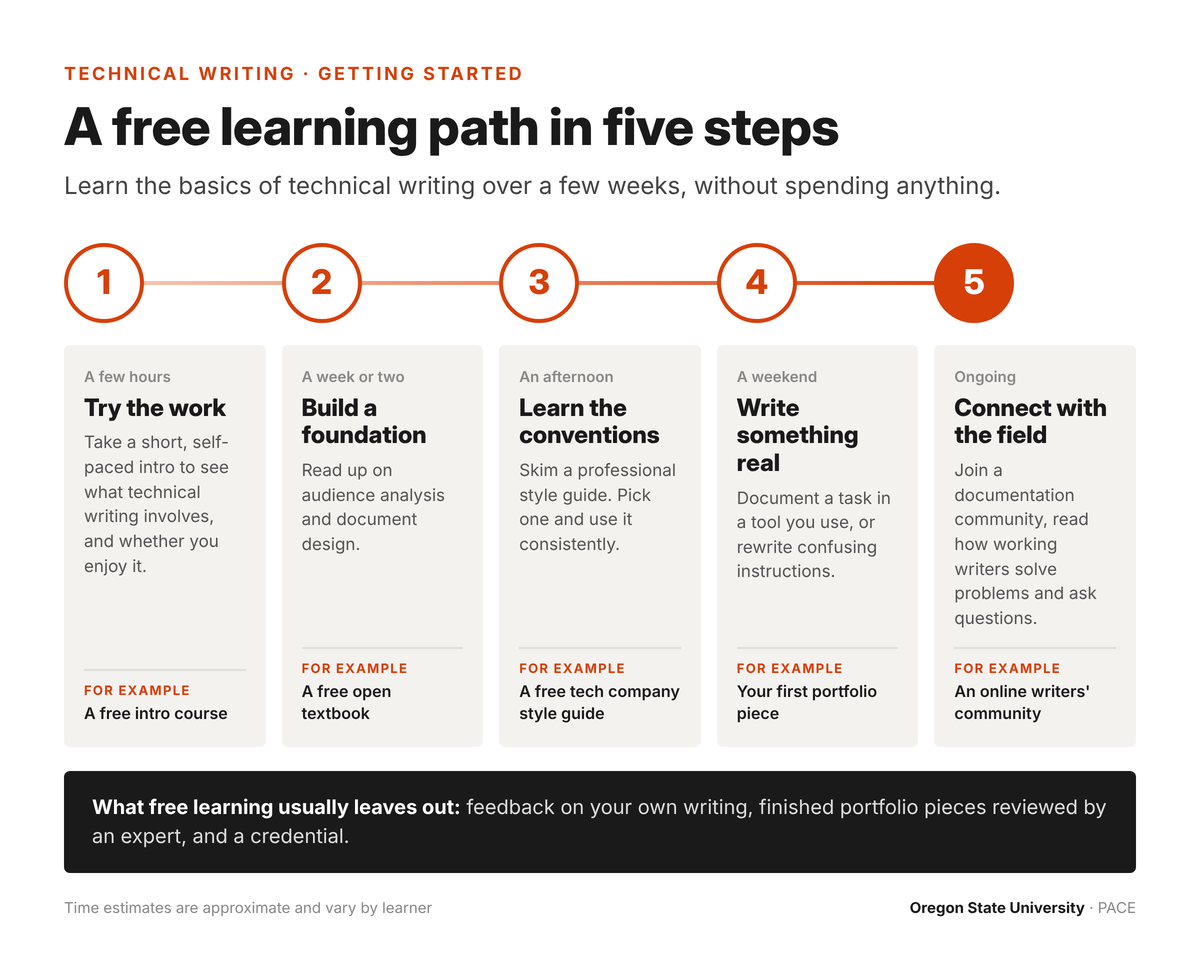
That fourth step matters most.
Writing is how you learn. And your first sample can become your first portfolio piece. Here's how to build a portfolio with no job experience.
Already work in a lab, clinic or plant? You may have a head start. See from the lab or clinic to technical writer.
What Free Options Usually Leave Out

Free resources are excellent for concepts.
But a few things are hard to get on your own:
- Feedback on your writing: Most free courses are self-paced. No one reviews your drafts. And feedback is the fastest way to improve.
- Finished portfolio pieces: You can write samples alone. It's hard to know if they're ready without an expert's eye.
- Structure and accountability: Without deadlines, it's easy to start strong and stall.
- A credential: Many free resources don't offer one. It isn't required to work as a technical writer, but some employers and funding programs look for recognized training.
(Wondering what employers actually screen for? Here's certificate or certification: what employers look for.)
Signs You're Ready for Structured Training
How do you know when to take the next step?
Try this quick self-check:
- Keep learning free if: You're not sure you'll enjoy it, you like teaching yourself, you haven't written a sample yet, or money is tight.
- You may be ready for more if: You finished a free course and liked it, you want honest critique, you have a target industry, or you need deadlines or proof of training.

Still exploring? That's fine.
Keep learning for free. There's no rush.
Ready to weigh the cost? Here's an honest look at whether a certificate is worth it. And if you're wondering about the future of the field, see will AI replace technical writers?
When You're Ready for More

Oregon State University's online Technical Writing Certificate adds what free resources leave out.
Weekly feedback from OSU writing instructors. Assignments that become portfolio pieces. And a university certificate with 16 CEUs.
Fully online. No prerequisites. No set class times. Take one course for $499 (+$70 registration fee), or all five for the certificate.
Want to hear from graduates? Read April Ponto's story.
Frequently Asked Questions

Are there free technical writing courses?
Yes. Options include Oregon State's Free Intro to Technical Writing, Google's free technical writing courses and free open textbooks such as Open Oregon's "Technical Writing."
Do free technical writing courses come with a certificate?
Many don't. Free courses are best for learning the basics and testing your interest. A credential isn't required to work as a technical writer, but it can help in some situations.
Can I become a technical writer with only free courses?
Some people do, especially if they have experience in a technical field and can build strong samples on their own. Most people find feedback on their writing speeds things up considerably.
Which free technical writing course is best for beginners?
It depends on your goals. Software-focused learners often start with Google's courses. Complete beginners may prefer a short intro course or an open textbook that covers workplace writing more broadly.
How long do free technical writing courses take?
Most take a few hours to a few weeks. Oregon State's Free Intro to Technical Writing takes about 2 to 10 hours, at your own pace.
Start Free Today
Why wait?
Enroll in the Free Intro to Technical Writing. It's self-paced and takes about 2 to 10 hours. You'll finish with a technical memo you can add to your portfolio.