

If you're thinking about technical writing, you've probably wondered.
Will AI make this job disappear?
It's a fair question.
Writing is one of the things AI tools do most. And technical writing shows up near the top of nearly every list of jobs affected by AI.
But "affected" isn't the same as "replaced."
Here's what the data actually shows. What AI does well. What still takes a person. And how to get ready.
The Short Answer About AI

AI is changing technical writing work. It isn't eliminating it.
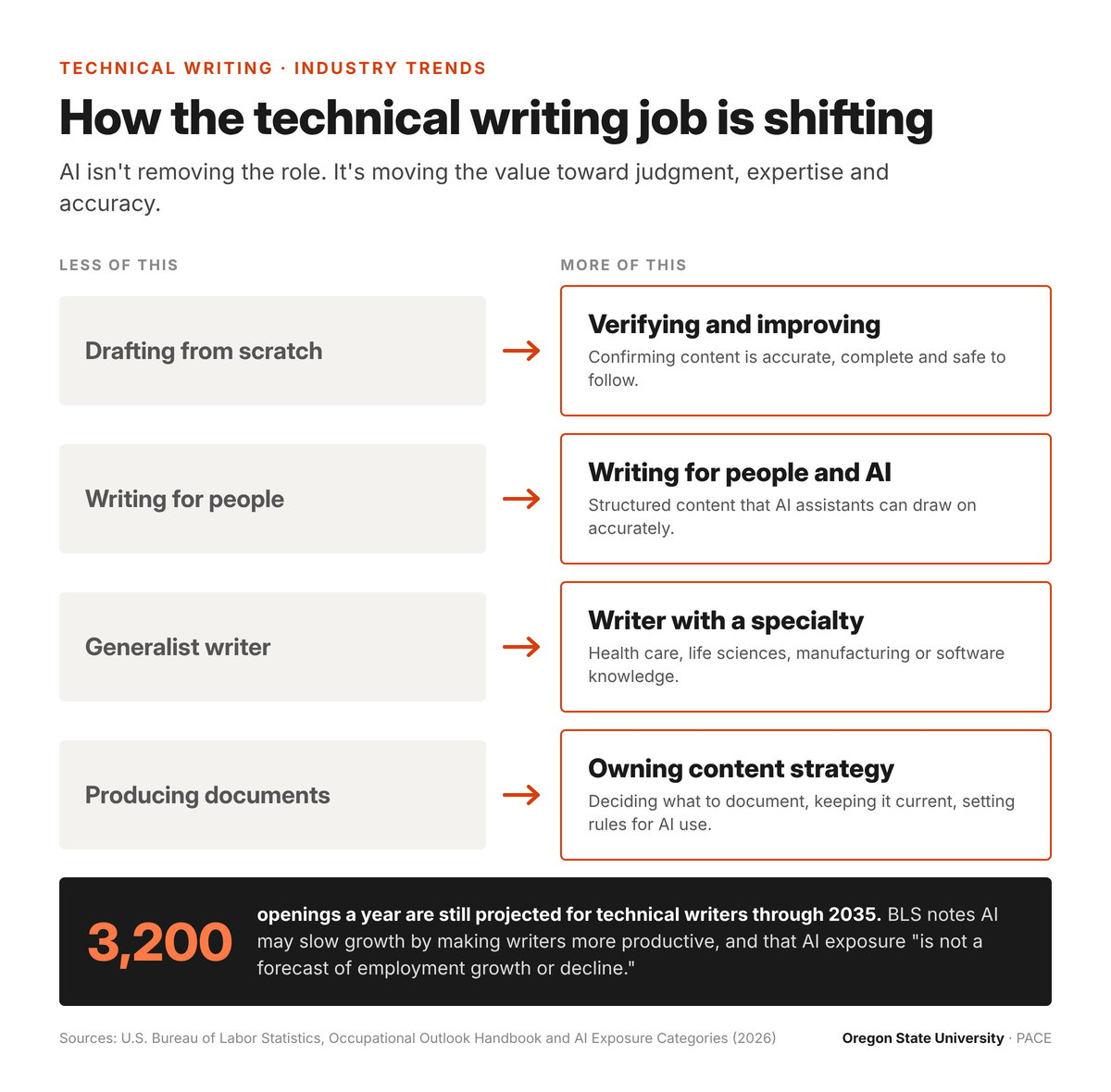
The U.S. Bureau of Labor Statistics (BLS) still projects about 3,200 technical writer openings a year through 2035.
At the same time, the work is shifting.
Toward the parts AI can't do on its own:
-
checking accuracy
-
understanding users
-
taking responsibility for what gets published
What the Data Says

More productive writers, steady openings
Let's start with the honest number.
BLS projects technical writer jobs to grow about 1 percent from 2025 to 2035. That's slower than the 3 percent average for all jobs.
Now look at the reason BLS gives. Growth "may be slowed by artificial intelligence (AI) tools that allow these workers to be more productive."
More productive.
That's the other side of the story.
AI can take on the busywork: first drafts, reformatting, consistency checks. That frees a skilled writer to spend more time on the parts that make documentation great.
-
Getting the facts right.
-
Understanding the reader.
-
Testing whether the steps actually work.
But AI doesn't make a weak writer strong.
It makes a good writer faster.
The writers who benefit most are the ones who can spot what an AI draft gets wrong, and know how to fix it.
So the field isn't disappearing. It's raising the bar. BLS still projects about 3,200 openings a year, and they tend to go to people with strong skills and good judgment. (For the full pay and outlook picture, see is a technical writing certificate worth it?)
"Exposed to AI" doesn't mean "losing jobs to AI"
In 2026, BLS began rating 831 occupations by how exposed they are to AI.
But BLS is clear about what those ratings mean: "An exposure category is not a forecast of employment growth or decline." A high rating "does not necessarily mean employment will decline."
That matters.
A job can be highly exposed because AI is useful for many of its tasks. Which can make the people doing it more productive, not unnecessary.
Technical writers already use AI heavily
- Microsoft Research (2025): A study of 200,000 anonymized Copilot conversations ranked technical writers among the 40 occupations where AI chatbots are most applicable. The researchers framed it as which jobs "can productively use AI chatbots," not which jobs will be lost.
- AI usage data (2025): Anthropic, the developer of the AI assistant Claude, analyzed about one million conversations. Usage was "concentrated in software development and technical writing tasks." And more of that use augmented people's work (57 percent) than automated it (43 percent).
Hiring is Tilting Toward Experience
Indeed Hiring Lab's 2026 job posting data shows two things.
The most AI-exposed occupations have seen the biggest rebound in postings since early 2025. And postings overall are "tilting toward seniority."
For newcomers, that means competition for junior roles is real. Showing good judgment in your samples matters more than ever.
People in the field feel both sides. In the 2025 Write the Docs salary survey, the share of documentation professionals who felt less secure in their jobs rose from about 22 percent to 36 percent.
Yet median pay in the same survey went up.
What AI Does Well, and What Still Needs a Person
Think of it this way.
AI brings speed. People bring judgment.
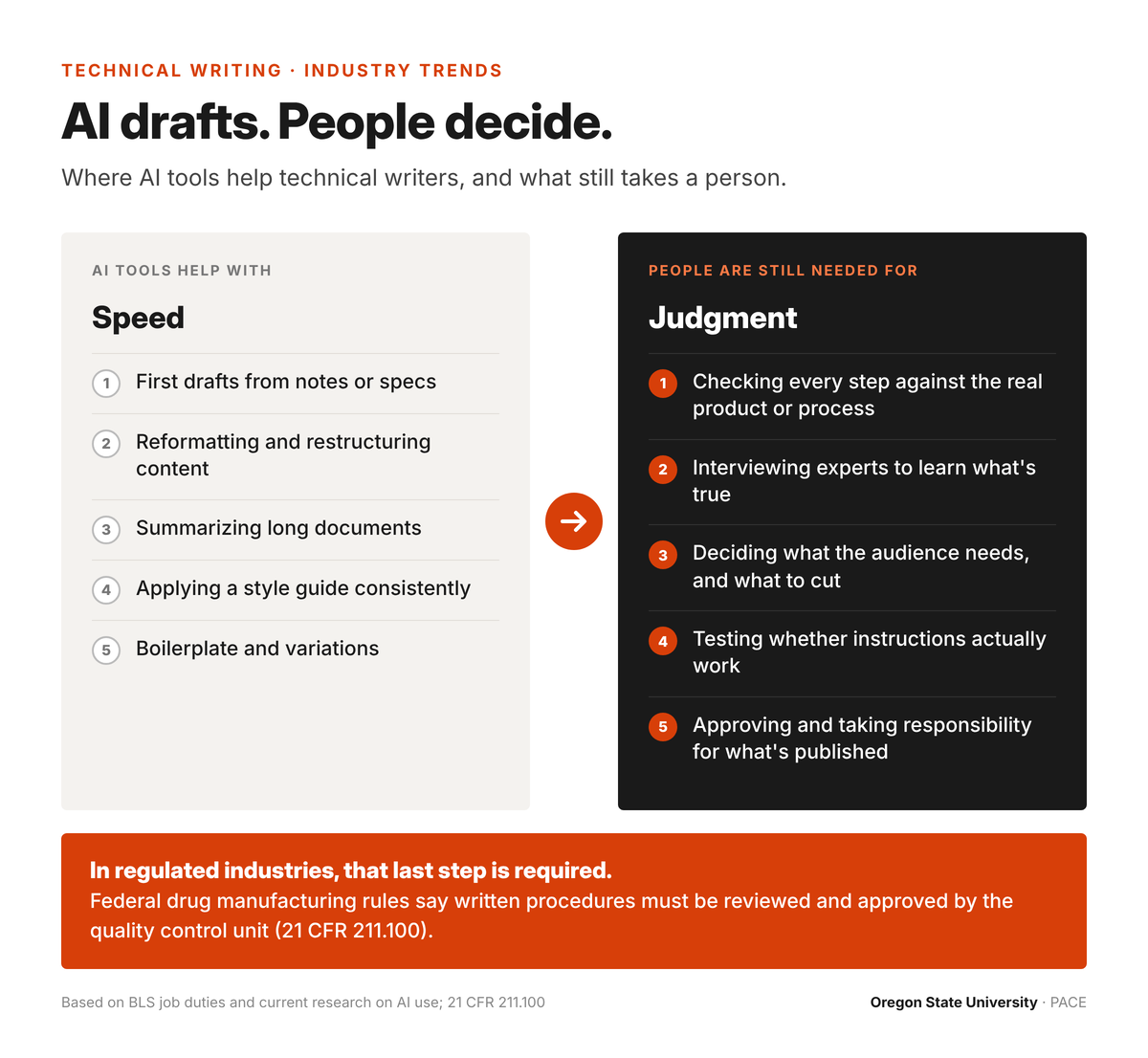
- AI tools help with: First drafts, reformatting, summarizing, applying a style guide, and boilerplate.
- People are still needed for: Checking accuracy against the real product, interviewing experts, deciding what the audience needs, testing instructions, and approving what's published.
That last one carries extra weight in regulated industries.
Under federal drug manufacturing rules, written procedures must be "reviewed and approved by the quality control unit" before use (21 CFR 211.100).
That responsibility belongs to qualified people. Not software. (Here's why precision matters so much in SOPs and contracts.
And if you work in a lab, clinic or plant, here's why your SOP experience counts.)
How the Job is Shifting

- From drafting to verifying: More time goes to confirming content is accurate and safe to follow, whoever wrote the first draft.
- Writing for people and AI: Clear, well-structured docs are what AI assistants draw on. Writers who organize content for both are increasingly valuable.
- Specialization: Writers who know a field, like health care, manufacturing or software, are harder to replace than generalists.
- Content strategy: Someone has to decide what gets documented, keep it current and set rules for AI use.
- AI fluency: Microsoft's 2025 New Future of Work report cites LinkedIn data showing job postings that require AI skills growing more than 70 percent a year.
What This Means if You're Getting Started

Good news: the skills that matter most are learnable.
And they're useful in almost any workplace, not just documentation teams.
- Build what AI can't supply on its own: Audience analysis, interviewing experts, editing for accuracy and testing instructions.
- Lean on what you already know: Subject knowledge is how you catch what an AI draft gets wrong.
- Learn AI tools, and when not to trust them: Checking and improving an AI draft is fast becoming part of the job.
- Show your judgment: Before-and-after edits with a short note on your choices show exactly what employers are hiring for. Here's how to build a portfolio that does that.
And remember: no certification is required. Employers care about what you can show. (More on what employers look for.)
About Oregon State's Technical Writing Certificate

Oregon State University's online Technical Writing Certificate focuses on the skills that last as tools change. Accuracy. Audience. Clear structure. Usability.
OSU writing instructors review every weekly assignment. You learn from a real editor, not an automated grader.
-
Five four-week courses.
-
Fully online.
-
No prerequisites, no set class times.
-
And you finish with a professional portfolio of your own work.
Frequently Asked Questions

Will AI replace technical writers?
Current evidence points to AI changing the work rather than replacing writers. BLS still projects about 3,200 openings a year through 2035, while noting that AI tools may slow growth by making writers more productive.
Is technical writing a dying career?
No data shows that. Growth is slow, about 1 percent from 2025 to 2035, and entry-level competition is tough. But openings continue, and median pay is well above the average for all workers.
Does high AI exposure mean a job will disappear?
No. BLS states that an AI exposure category "is not a forecast of employment growth or decline." High exposure often means AI is useful for the work, not that the role goes away.
What skills do technical writers need now?
Accuracy checking, interviewing subject matter experts, audience analysis, editing, structured writing, knowledge of a technical field, and the ability to use AI tools well and check their output.
Should technical writers learn to use AI?
Yes. Employers increasingly expect AI skills across many roles. The most valuable skill is knowing how to verify and improve what AI produces.
See If It Fits You

The best way to find out if technical writing suits you?
Try it.
Start the Free Intro to Technical Writing. It's self-paced and takes about 2 to 10 hours. Want more free options first? Here are the best free technical writing courses.
Sources: U.S. Bureau of Labor Statistics, Occupational Outlook Handbook: Technical Writers; BLS, AI Exposure Categories; Tomlinson et al., "Working with AI," Microsoft Research (2025); Anthropic Economic Index (2025); Indeed Hiring Lab (2026); Write the Docs Salary Survey 2025; Microsoft, New Future of Work Report 2025; 21 CFR 211.100.