


Technical writing training can be free.
Or it can cost several thousand dollars.
If you're considering a career change or looking to build new skills, it's worth asking two questions:
-
What will you get for your money?
-
And do you need to spend anything at all?
Let's look at ...
-
what technical writers earn
-
what the job market looks like
-
how much training costs
-
how long it takes to get started
Then you can decide which path makes sense for you.
What Do Technical Writers Earn?

Technical writing can offer a solid income, especially for people who combine strong writing skills with knowledge of a technical field.
The U.S. Bureau of Labor Statistics (BLS) reports a median annual wage of $90,390 for technical writers in May 2025. That's compared with $50,980 for workers across all occupations.
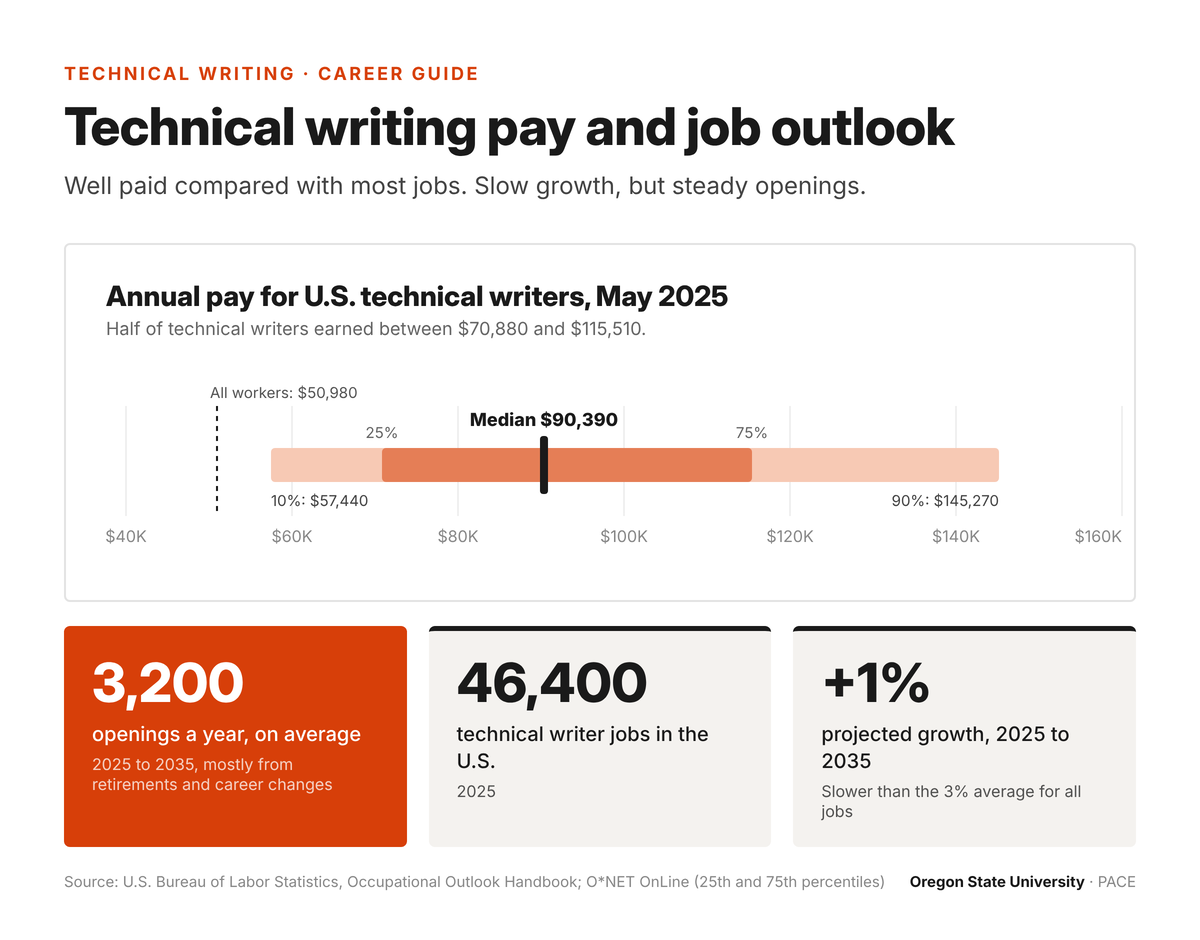
Pay varies with experience, industry and employer. Half of technical writers earned between $70,880 and $115,510 annually. The top 10 percent earned more than $145,270.
Your industry can make a difference, too.
| Industry | Median pay | Share of jobs |
|---|---|---|
| Professional, scientific and technical services | $94,520 | 39% |
| Information (software, publishing, telecom) | $86,400 | 13% |
| Manufacturing | $82,860 | 13% |
| Administrative and support services | $99,280 | 8% |
| Government | $95,480 | 4% |
What about Oregon?
In the Portland metro area, the Oregon Employment Department reports median pay of approximately $40 an hour, or about $83,000 a year, as of May 2025.
Remote opportunities can also expand your options beyond local employers, although remote work isn't available in every position.
The Job Outlook: What to Expect
There's encouraging news for people considering the field: technical writing continues to offer job opportunities across several industries.
-
The BLS projects approximately 3,200 openings per year for technical writers through 2035.
The BLS also notes that AI tools could affect demand by helping technical writers work more efficiently.
Explore how AI may change technical writing and what that could mean for your career.
The takeaway?
There are opportunities, but landing a job isn't automatic. You can stand out with:
-
Strong writing samples
-
Relevant subject knowledge
-
The ability to communicate clearly
How Do People Become Technical Writers?

There's no single route into technical writing.
Your best path depends on your education, work experience and the kind of content you want to create.
According to the BLS, employers generally prefer candidates with a bachelor's degree, often in English, communications or journalism. Knowledge of a technical subject, such as science, engineering or information technology, can also be an advantage.
But you don't necessarily have to start with a writing degree.
Some technical writers begin as specialists in another field and move into writing later. If you've worked in a lab, clinic or manufacturing facility and already create procedures, protocols or reports, you may have relevant experience to build on.
Learn how to transition from a lab or clinical role into technical writing.
And do you need a license or professional certification? No. Find out what credentials mean and what employers look for instead.
How Much Does Technical Writing Training Cost?
Technical writing education ranges from free online resources to university programs costing several thousand dollars. The right choice depends on what you need to learn and how you prefer to learn it.
Here are four common options and what you can generally expect from each.

- Free courses and open textbooks: Learn foundational concepts without paying tuition. These resources typically offer limited personalized feedback and may not include a credential or finished portfolio pieces.
- Self-paced video programs (often a few hundred dollars): Work through recorded lessons on your own schedule. Some include projects and a certificate of completion, but individual feedback may be limited.
- University continuing education certificates (about $1,500 to $4,200): Follow a structured curriculum with assignments, instructor feedback and a university certificate. These programs are generally non-credit and may be accessible without a degree.
- Graduate certificates and degrees (several thousand dollars or more): Pursue advanced academic study, often with college credit. Admission commonly requires a bachelor's degree.
You don't have to pay for training to start learning. If you're still exploring the field, check out these free technical writing courses and resources.
Compare the Value, not Just the Price

A program's price doesn't tell you everything about what you'll get.
For example, a $300 program with 20 hours of recorded videos offers a different learning experience from a $2,500 program with 160 hours of instruction and instructor feedback.
One way to compare programs is to divide the total cost by the hours of instruction. But don't stop there. Ask what those hours include and what you'll be able to do when you finish.
- Who reviews your work? Will an instructor provide regular feedback, review a final project or leave you to evaluate your own writing?
- How much writing will you do? Look at the number and variety of documents you'll create, not just the number of videos you'll watch.
- What will you finish with? Will you have portfolio samples you can show employers and a credential that supports your professional goals?
- Can you start small? A free introductory course or a single paid class can help you explore the field before committing to a larger program.
How Long Does it Take to Become a Technical Writer?

There's no official timeline. How long it takes depends on your starting point, the time you can dedicate to learning and the type of work you want to pursue.
- Exploring the field: Spend a few hours or several weeks learning the basics through free courses and other resources.
- Building a starter portfolio: Allow several months to write, revise and polish three to five strong samples.
- Completing a structured certificate: Many programs can be completed over six months to a year of part-time study, depending on the curriculum and your pace.
Completing a course or portfolio is only part of the process. You'll also need time to identify suitable roles, prepare applications and interview with employers.
If you already have experience in health care, engineering, science or another technical field, you may be able to build on skills you already use at work. Whatever your background, a portfolio can help demonstrate what you can do.
Here's how to build one without previous technical writing experience.
Start with free resources if...
- You're still deciding whether technical writing is right for you. Try an introductory course before investing in a longer program.
- You're comfortable learning independently. Free lessons, style guides and open textbooks can help you develop foundational knowledge.
- You need to keep costs down. Start building writing samples on your own and consider paid training later if you need additional guidance.
Consider paid training if...
- You want feedback on your writing. Getting useful, consistent feedback can be difficult on your own. An experienced instructor can help you identify problems and improve your work.
- You need portfolio-ready samples. Structured assignments give you opportunities to create documents that demonstrate your skills to employers.
- You benefit from deadlines and structure. A defined schedule can help you make progress while balancing work and other responsibilities.
- You need a credential. Some employers, tuition assistance programs or education awards may require proof of completed training.
The goal isn't to choose the most expensive program. It's to find the training that gives you the skills, feedback and practical experience you need.
Explore Oregon State's Technical Writing Certificate

If you're looking for structured training with instructor feedback and practical writing experience, Oregon State University's online Technical Writing Certificate offers a guided path to developing your skills.
The program consists of five four-week courses, with 160 hours of instruction and 16 continuing education units (CEUs).
The total cost is $2,495, plus a $70 registration fee. That's approximately $16 per hour of instruction.
Oregon State writing instructors provide feedback on every weekly assignment, helping you strengthen your work as you progress through the program. In the final course, you'll bring your work together in a professional WordPress portfolio.
There are no prerequisites or set class times. You can also explore the subject before committing to the full certificate by taking the Free Intro to Technical Writing, or enroll in an individual course for $499, plus a $70 registration fee. AmeriCorps Education Awards are accepted.
Want to hear how the training helped other students? Read April Ponto's story of doubling her salary and how Samantha Edington launched a new career.
Frequently Asked Questions

How much do technical writers make?
The median pay for technical writers was $90,390 in May 2025, according to BLS. The lowest 10 percent earned less than $57,440, and the highest 10 percent earned more than $145,270.
Is technical writing a growing field?
Slowly. BLS projects about 1 percent growth from 2025 to 2035, with about 3,200 openings a year, mostly from people retiring or changing careers.
How much does a technical writing certificate cost?
It depends on the type. Free courses cost nothing, self-paced video programs often cost a few hundred dollars, and university continuing education certificates commonly run about $1,500 to $4,200.
Can I become a technical writer without a degree?
BLS reports that employers generally prefer a bachelor's degree. Strong writing samples and experience in a technical field can carry real weight, especially for career changers.
How long does it take to become a technical writer?
There's no set timeline. Many people spend several months building a portfolio of three to five samples, and structured certificates commonly take six months to a year part time.
Try it Before You Decide

The best way to know if technical writing fits you?
Try it.
Start the Free Intro to Technical Writing. It's self-paced, takes about 2 to 10 hours, and you'll write your first technical memo along the way.
Sources: U.S. Bureau of Labor Statistics, Occupational Outlook Handbook: Technical Writers (pay, industries, outlook, education); O*NET OnLine, U.S. Department of Labor: Technical Writers (25th and 75th percentile pay); Oregon Employment Department, QualityInfo (Portland metro wages).