


Have you ever written a standard operating procedure?
Updated a work instruction? Explained a protocol so a new coworker could follow it step by step?
Then you may already have experience in technical writing.
You just may not have called it that.
If you work in, say, a ...
-
lab
-
clinic
-
quality department
-
manufacturing facility
You may have more transferable skills than you realize.
Here's how your experience translates to technical writing, which job titles to search for, and how to build a portfolio without sharing confidential workplace documents.
You're Closer to Technical Writing Than You Think

You don't necessarily need to start your career over to move into technical writing.
The U.S. Bureau of Labor Statistics (BLS) notes that "Some technical writers begin their careers as specialists or research assistants in a technical field."
From there, they develop their writing skills and move into documentation-focused roles.
The BLS also identifies knowledge of a technical subject, such as science or engineering, as an advantage.
That's where your experience can help.
Writing conventions can be taught. Understanding how a laboratory operates, how a clinical procedure works or what happens on a production line takes more specialized experience. If you already understand the work, you have knowledge that documentation teams may need.
You May Already Be Writing Technical Documents
Think about the documents you create or maintain in your current role. Many of the tasks you already perform map directly to technical writing responsibilities.

- Standard operating procedures (SOPs): You turn complex processes into clear, repeatable steps that others can follow.
- Work instructions and test methods: You explain how to complete a specific task, with the right information in the right order.
- Protocols and batch records: You document processes precisely so others can reproduce the work and verify what happened.
- Deviation reports and corrective and preventive actions (CAPAs): You explain what went wrong, document findings and communicate how issues are addressed.
- Validation and change control documents: You track revisions, document approvals and help ensure people use current, accurate information.
- Training materials and patient handouts: You explain technical concepts to people who may not share your professional background.
These aren't just administrative tasks. They involve organizing information, understanding your audience, communicating accurately and helping people complete work correctly. Those are core technical writing skills.
Why Experience in a Regulated Industry is Valuable

In regulated industries, documentation is more than a convenience. It's part of how organizations demonstrate that their processes meet required standards and are carried out correctly.
- Drug manufacturing: Federal regulations require written production and process control procedures. Under 21 CFR 211.100, these procedures must be reviewed and approved by the quality control unit, and deviations must be recorded and justified.
- Medical devices: The FDA's Quality Management System Regulation (QMSR), effective February 2, 2026, aligns U.S. medical device quality system requirements more closely with the international standard ISO 13485.
- Quality management systems: Standards such as ISO 9001 include requirements for controlling documented information so that appropriate, current documents are available where they're needed.
If you've worked in an environment like this, you already understand why a procedure needs to be accurate, why changes must be tracked and why unclear instructions can create real problems.
You may also be familiar with review cycles, approvals, audits and the importance of getting the details right. These experiences can help you transition into documentation roles.
Learn more about why precision matters in SOPs, grants and contracts.
These skills also matter as AI tools become more common in technical writing.
AI can help draft or revise content, but organizations still need people with the expertise to check accuracy, understand context and approve documentation. Read more about whether AI will replace technical writers.
The Skills You Can Bring to Technical Writing

Your current job may have already helped you develop several skills that technical writing employers value.
- Precision: The BLS notes that technical writers must be precise about every step. Your experience following or documenting detailed procedures can be directly relevant.
- Subject matter knowledge: Because you understand the work, you may recognize missing steps, inaccurate details or practical problems that someone outside your field might overlook.
- Communication with experts: You already understand the terminology and workflows used by scientists, clinicians, engineers or other specialists.
- Version and change control: You know how documents are reviewed, revised, approved and maintained.
- Audit readiness: You understand the importance of accurate records and documentation that can withstand scrutiny.
- Training and instruction: If you've helped a new employee learn a procedure, you've already practiced explaining technical information to a specific audience.
Your next step is learning how to apply these strengths to the kinds of documents and audiences you'll encounter in a technical writing role.
Technical Writing Job Titles to Search

Technical writing jobs don't always use the title "technical writer." Searching for related positions can help you find opportunities that align with your existing experience.
- Technical writer: Creates instructions, manuals, procedures and other technical documentation across a range of industries.
- Documentation specialist: Develops, updates and maintains manuals, procedures and controlled documents.
- SOP writer: Drafts and maintains standard operating procedures, often within a quality, manufacturing or health care environment.
- Quality documentation or document control specialist: Helps manage document revisions, approvals, records and other documentation required by a quality management system.
- Medical or regulatory writer: Develops scientific, clinical or regulatory documents. Some positions require more specialized scientific knowledge or experience, particularly those involving clinical study reports and regulatory submissions.
Your industry experience can help you narrow the search. Someone with laboratory experience might explore life sciences documentation, while a manufacturing technician might look for SOP, quality documentation or work instruction roles.
Pay can make the transition worth exploring. The BLS reports median annual pay of $90,390 for technical writers overall and $82,860 in manufacturing, based on May 2025 data.
Health care employment is also projected to grow faster than average across the broader economy through 2035, although that doesn't guarantee growth in any particular technical writing specialty.
Explore the salary figures and career considerations in our guide to technical writing certificates and career prospects.
Build a Portfolio Without Sharing Confidential Documents
If there's one thing to get right as you prepare for a technical writing career, it's this: Don't use your employer's actual work documents in your portfolio without explicit authorization.
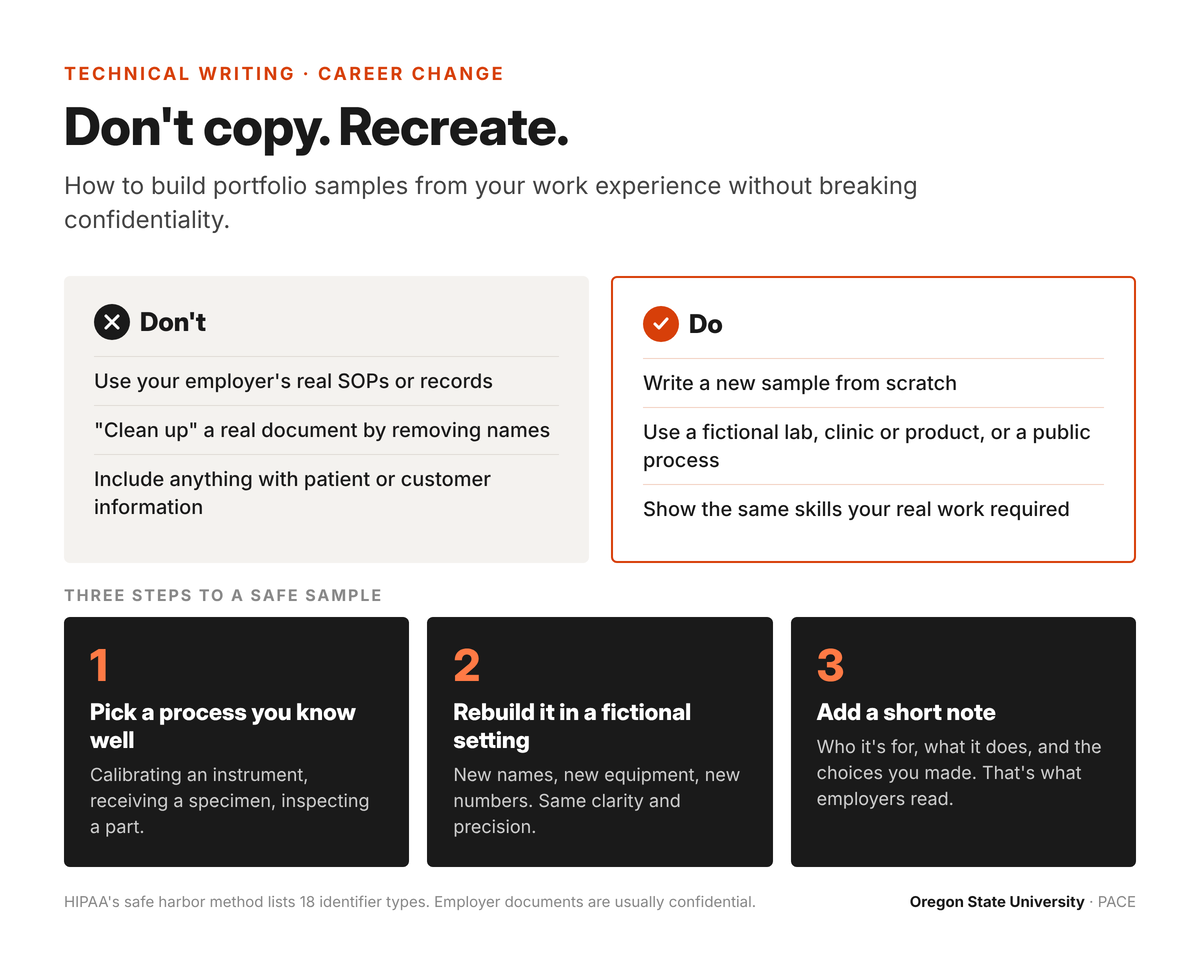
Why does this matter?
- Your employer's documents may be confidential: Internal procedures, records and other workplace materials may belong to your employer or be subject to confidentiality restrictions, even if they contain no personal information.
- Health information requires special care: HIPAA governs protected health information. Its Safe Harbor method for de-identification requires removing 18 categories of identifiers, and simply removing names may not be enough to protect someone's identity. Review the U.S. Department of Health and Human Services guidance.
- Creating a new sample demonstrates your skills: You can show employers how you organize information, write clear instructions and apply technical knowledge without exposing workplace information.
Ideas for Portfolio Samples You Can Create

You don't need access to real workplace documents to demonstrate your abilities. Start with a process you understand, then create a new example in a fictional setting or use publicly available information.
- An SOP for a fictional laboratory: Write instructions for calibrating an instrument, receiving a specimen or cleaning a workstation.
- A patient education handout: Explain how to prepare for a common procedure using clear, accessible language. Use fictional details and reliable public information.
- A work instruction with a flowchart: Show how to assemble or inspect a simple product, with each step presented in a logical sequence.
- A before-and-after rewrite: Find confusing instructions in a public document, rewrite them for clarity and explain the improvements you made.
For each sample, briefly explain its intended audience, purpose and the decisions you made when organizing the information. That gives potential employers a better sense of how you approach documentation.
Need more ideas? Read how to build a technical writing portfolio without job experience.
A Practical Plan for Making the Transition

You don't have to figure everything out at once.
Start by identifying the skills you already have, then build on them.
- Inventory your writing experience: List the procedures, forms, reports, protocols and training materials you've created or maintained. Include documents you've revised and processes you've helped explain to coworkers.
- Choose your target roles: Decide whether you want to stay in your current industry, where your subject knowledge may be an advantage, or explore another field.
- Create three to five original samples: Choose examples that align with the jobs you're targeting. Include at least one procedure or set of instructions, and create everything from scratch using fictional or public information.
- Get feedback: Ask an experienced technical writer, instructor or knowledgeable reviewer to evaluate your samples before you share them with employers.
- Translate your experience for your résumé: Describe your work in terms that highlight documentation skills. For example, you might write, "Authored and revised 20 standard operating procedures for a regulated laboratory," if that accurately reflects your experience.
You don't necessarily need a certification before you start applying. What matters is understanding the requirements of the roles you want and being able to demonstrate your skills. Learn what employers look for in technical writers.
How Oregon State's Technical Writing Certificate Can Help

If you're ready to build on your professional experience, Oregon State University's online Technical Writing Certificate offers structured training in practical writing skills.
The program can be particularly relevant if you're an early-career STEM or health care professional who understands technical processes and wants to develop the writing skills to document them effectively.
The Technical Editing: SOPs and Flowcharts course focuses on document types relevant to many regulated workplaces, including procedures and flowcharts.
Oregon State writing instructors provide feedback on every weekly assignment, so you can apply what you learn and improve your work as you progress.
The program is fully online, has no prerequisites or set class times, and culminates in a professional portfolio built from your own work.
One graduate has gone on to work as a Clinical SOP Writer at Providence Health, illustrating one possible career direction for someone interested in technical documentation in health care.
Frequently Asked Questions

Can a nurse or lab technician become a technical writer?
Yes. The BLS notes that some technical writers begin as specialists in technical fields. Experience creating SOPs, protocols, reports or patient education materials can provide a useful foundation for moving into documentation work. You'll still need to demonstrate that you can write clearly for your intended audience.
What does an SOP writer do?
An SOP writer creates and maintains standard operating procedures that explain how tasks should be performed consistently. These roles are common in quality, health care, life sciences and manufacturing environments, where accurate documentation is essential.
Is medical writing the same as technical writing?
The fields overlap, but they're not identical. Medical writing can include patient education, clinical documentation and regulatory submissions. Some specialized medical and regulatory writing roles require substantial scientific knowledge or experience. The federal O*NET database includes medical writer among the titles associated with technical writing.
Can I use my workplace SOPs in a portfolio?
Don't assume you can. Workplace documents may be confidential or owned by your employer, and removing names doesn't necessarily make them safe to share. Unless you have explicit authorization, create original samples using fictional scenarios or public information instead.
What changed for medical device documentation in 2026?
The FDA's Quality Management System Regulation (QMSR) took effect on February 2, 2026. It aligns U.S. medical device quality system requirements with ISO 13485, the international standard for medical device quality management systems. People working in medical device manufacturing and quality may find it useful to understand the documentation practices associated with these requirements.
Find Your Technical Writing Fit

Your professional background can point you toward certain technical writing specialties, but you may have more options than you realize.
Take our free 3-minute technical writing quiz. Explore whether documentation, UX writing, API writing or content strategy might fit your interests and strengths.
Prefer to explore independently first? Start with the best free technical writing courses and begin developing your skills at your own pace.
Sources: U.S. Bureau of Labor Statistics, Occupational Outlook Handbook: Technical Writers; BLS Employment Projections 2025 to 2035; O*NET OnLine: Technical Writers; 21 CFR 211.100; FDA, Quality Management System Regulation FAQ; HHS, HIPAA De-identification Guidance.