


If you've ever planned a unit backward from the final assessment, rewritten a lesson because half the class didn't get it, or built a rubric so students knew exactly what "good" looked like, you've already done instructional design.
You just called it teaching.
That's why teaching is one of the most common paths into instructional design. The hard part usually isn't learning a whole new job.
It's translating what you already do into the language employers use, filling a few specific gaps, and showing your work in a portfolio.
Here's how to make that translation, what to learn next, and how to land your first role.
Why Teachers Make Strong Instructional Designers

In a 2024 survey of 101 instructional design hiring managers, the top skills they wanted were ...
-
the ability to apply instructional design theory (71% ranked it in their top three)
-
communication (69%)
-
e-learning development (64%)
Teachers walk in with a head start on the first two.
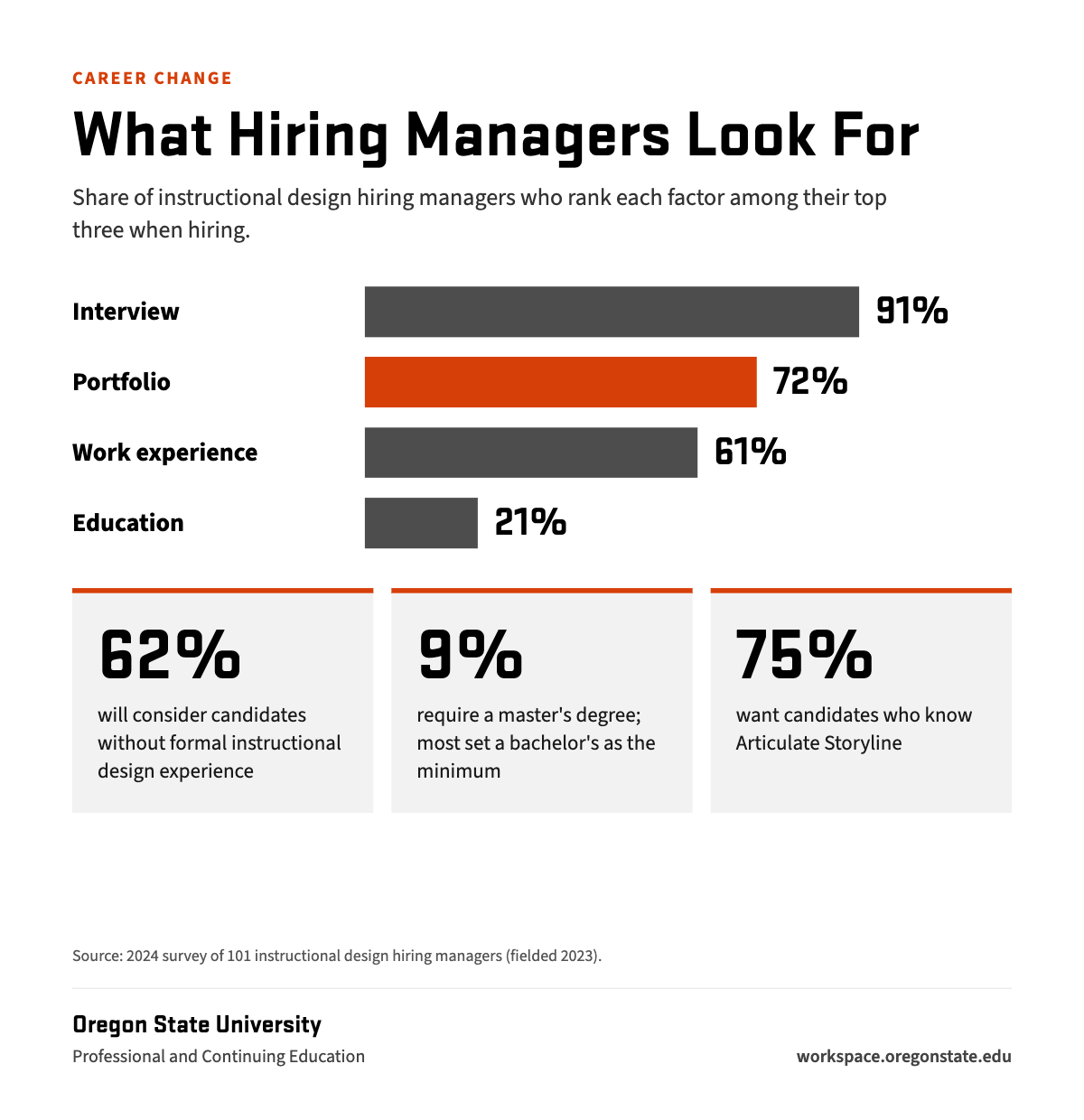
The same survey found that 62% of hiring managers will consider candidates without formal instructional design experience.
Experience still matters, but a strong portfolio can open the door.
Your Classroom Skills, Translated
Instructional designers and teachers often do the same things under different names.
Here's what to show employers for each one. Use the middle column's terms on your résumé, in your portfolio and in interviews.
| In the classroom | In instructional design | What to show employers |
|---|---|---|
| Lesson and unit plans | Design documents and storyboards | A design document with audience, objectives, strategy and assessment plan |
| Backward design | ADDIE, SAM and action mapping | Clear alignment from objectives to assessments to activities |
| Learning targets and "I can" statements | Measurable performance objectives | Objectives with a behavior, a condition and a standard |
| Rubrics and formative checks | Assessment strategy and evaluation (Kirkpatrick levels) | An assessment blueprint and a plan to measure results |
| Differentiation, IEPs and 504 plans | Learner analysis, accessibility and Universal Design for Learning | Learner personas and an accessible build |
| Classroom management and discussion | Facilitation, including virtual instructor-led training | A facilitator guide |
| Working with parents and administrators | Stakeholder and subject matter expert (SME) management | A short case study of how you worked with an expert |
| Data-driven instruction | Learning analytics and business impact | A result tied to performance, not just quiz scores |
| Pacing guides and curriculum maps | Project management and curriculum architecture | A project timeline with milestones and review cycles |
The Gaps to Close

Teaching covers a lot, but not everything.
When hiring managers named the skills candidates most often lack, three came up most. They're worth working on first.
- Designing for Adults at Work: Adult learners want to know why something matters to their job, and they bring their own experience. Applying design theory in a workplace setting was the most-cited gap.
- Business Results: In schools, success is often measured in grades. At work, it's measured in performance: fewer errors, faster onboarding, better customer service. Learn to start every project with the business problem.
- Project Management: Instructional designers juggle deadlines, reviewers and subject matter experts across several projects at once.
Authoring tools matter too. Articulate Storyline was the tool hiring managers most wanted candidates to know (75%), followed by experience with a learning management system (LMS).
You don't need to master every tool before you apply, but you should be able to build something.
What to Put in Your Portfolio

Your portfolio usually carries more weight than your résumé. In the same survey, 72% of hiring managers ranked the portfolio among their top three hiring factors.
- Three to Five Varied Samples: For example, an interactive scenario, a job aid, an assessment, a short video or microlearning piece, and a design document or storyboard. Avoid a portfolio of all one format.
- The "Why" Behind Each Piece: A short design statement covering the problem, the audience, your role and why you made the choices you did. Hiring managers say they care more about your design thinking than a polished finish.
- Workplace Topics: Turn a professional development session you led into a self-paced module, or redesign a dull onboarding or compliance training. Classroom lessons can work, but adult, workplace examples show you can make the shift.
- Accessibility: Build to WCAG 2.1 AA: keyboard navigation, alt text, captions and enough color contrast. You already know how to plan for different learners; this is the digital version.
Four Common Misconceptions

- "I have to finish a master's before I can start." Many people start with a certificate and a strong portfolio, then go on to a master's as their careers grow. A master's is especially valuable for university, federal and leadership roles, and about 40% of hiring managers in the survey prefer candidates who have one. Choosing a certificate whose units count toward a master's lets you start now and keep building."
- "Every instructional design job is remote." Many are, but not all. About a quarter of hiring managers in the survey hadn't hired remote designers, so be open to hybrid and on-site roles, especially for your first job.
- "It's just making slides." The job is analysis, design, development and evaluation. Slides and modules are only the visible part.
- "I'll automatically earn more." It depends on the sector. Kindergarten and elementary teachers earn a median of $63,820, according to the U.S. Bureau of Labor Statistics (May 2025). Training and development specialists earn a median of $69,280, and instructional coordinators $77,440. Corporate roles generally pay more than higher education roles.
How to Land Your First Instructional Design Role

- Rewrite your résumé in instructional design terms. Skip "dedicated educator seeking to transition." Lead with what you designed and the results, using the translation terms above, and put your portfolio link at the top.
- Look inside your district first. Instructional technology coach, curriculum writer, LMS administrator and professional development lead are all natural first steps that build relevant experience.
- Consider adjacent roles. Corporate trainer, e-learning developer, customer education specialist and instructional coordinator all use your skills. BLS projects about 46,000 openings a year for training and development specialists through 2035.
- Take on a real project. Volunteer to build training for a nonprofit, or use a course practicum to design a complete project for a real audience. A real project gives you a stronger portfolio piece and a story to tell in interviews.
- Pick a direction. Corporate, health care, higher education and government each value slightly different things. Tailoring your portfolio to one helps you stand out in a competitive entry-level market.
One Graduate's Path
I learned a lot about instructional design and many software tools needed for this career. It gave me the skills and experience to switch jobs from teaching to corporate instructional design. ~ Laurie Washburne, graduate of OSU's E-Learning Instructional Design and Development Certificate
Where Oregon State Can Help

Oregon State's E-Learning Instructional Design and Development Certificate was built with OSU's College of Education for people making exactly this move.
-
It's 100% online and asynchronous, about 3 to 6 hours a week, with feedback from experienced instructors.
-
You'll work on adult learning, assessment, evaluation and project management, and finish with a practicum project you design yourself: a ready-made portfolio piece.
-
There's no application.
-
Take one course for $479, or all five for the certificate.
After you finish, you can apply six units toward a partner online master's in learning design and technology, so the degree path stays open if you want it later.
Not sure where to start?
Try the free one-hour Pathways to Instructional Design course, or take the free 3-minute Skill Gap Analyzer to see which of your skills already transfer and what to work on next.
Frequently Asked Questions

Do teachers need a master's degree to become instructional designers?
Many teachers start with a certificate and a portfolio, then pursue a master's later. A master's is especially valuable for university, federal and leadership roles, and some certificates, including OSU's, carry units that count toward one.
How long does it take to move from teaching to instructional design?
It varies with how much time you have and how quickly you build portfolio pieces. Many career changers take several months to a year or more. A structured program with a practicum can keep you on track while you're still teaching.
Can I study instructional design while I'm still teaching?
Yes. Asynchronous online courses let you work on your own schedule. OSU's certificate courses take about 3 to 6 hours a week, with no set class times.
What software should I learn first?
Articulate Storyline is the tool employers ask for most, followed by LMS experience. Start with design skills, then learn the tools you'll use to build. Free trials let you practice before you buy.