

 Look up the cost of an instructional design certificate and you'll usually see the tuition price.
But tuition isn't the only expense.
You may also need ...
-
software
-
a computer that can run it
-
time each week to study and build projects
These extra costs are easy to overlook.
This guide breaks down the main options, including free ways to learn, so you can choose a path that fits your goals and budget.
This guide compares free resources, online courses, bootcamps, and university certificates. If you're considering a master's degree, read how a certificate can count toward one.
Five Ways to Get Started, Compared
The prices below are published tuition ranges as of October 2026.
Costs can change, so check each provider's website before enrolling.
| Path | Typical tuition | Typical time | What you get |
|---|---|---|---|
| Free resources | $0 | Self-paced | Free intro courses, videos, community forums and free tools; no feedback or credential |
| Online course platforms | About $35 to $59 a month, or $239 to $399 a year | Weeks to months | Self-paced video courses and a completion certificate; little or no instructor feedback |
| Short university courses and certificates | About $350 to $3,350 | A few weeks to a few months | One to a few instructor-led courses on a specific skill or tool |
| Comprehensive university certificates | About $4,800 to $5,300 | 8 to 18 months | Five or six instructor-led courses, a portfolio project, a university credential, and sometimes credit toward a master's |
| Bootcamps and career schools | About $799 to $9,900 | 7 weeks to 6 months | Intensive training; higher tiers add mentoring or job-search help |
Teaching yourself can cost little or nothing, but it often takes longer. Designers commonly estimate that it can take 9 to 18 months to build a portfolio that is ready for job applications when you're learning on your own.
The Free Options, Honestly

You can learn the basics without paying for a program. Here are a few good places to start:
- Free intro courses: Short courses that explain what instructional designers do and whether the work fits you, such as OSU's free one-hour Pathways to Instructional Design.
- Free software trials: Articulate 360 offers a 14-day free trial, enough time to build a small practice project.
- Free and open-source tools: H5P for interactive content, Canva's free tier for visuals, and Google Slides, Forms and Sites for simple modules and a portfolio site.
- Community and video resources: Free videos, blogs and online communities where designers share templates and answer questions.
Free resources can teach you a lot, but they usually don't provide a step-by-step plan, expert feedback, or a formal credential. Those are some of the main benefits you pay for in a structured program.
The Hidden Cost: Software
Articulate Storyline is the software employers ask about most often, but it can be expensive.
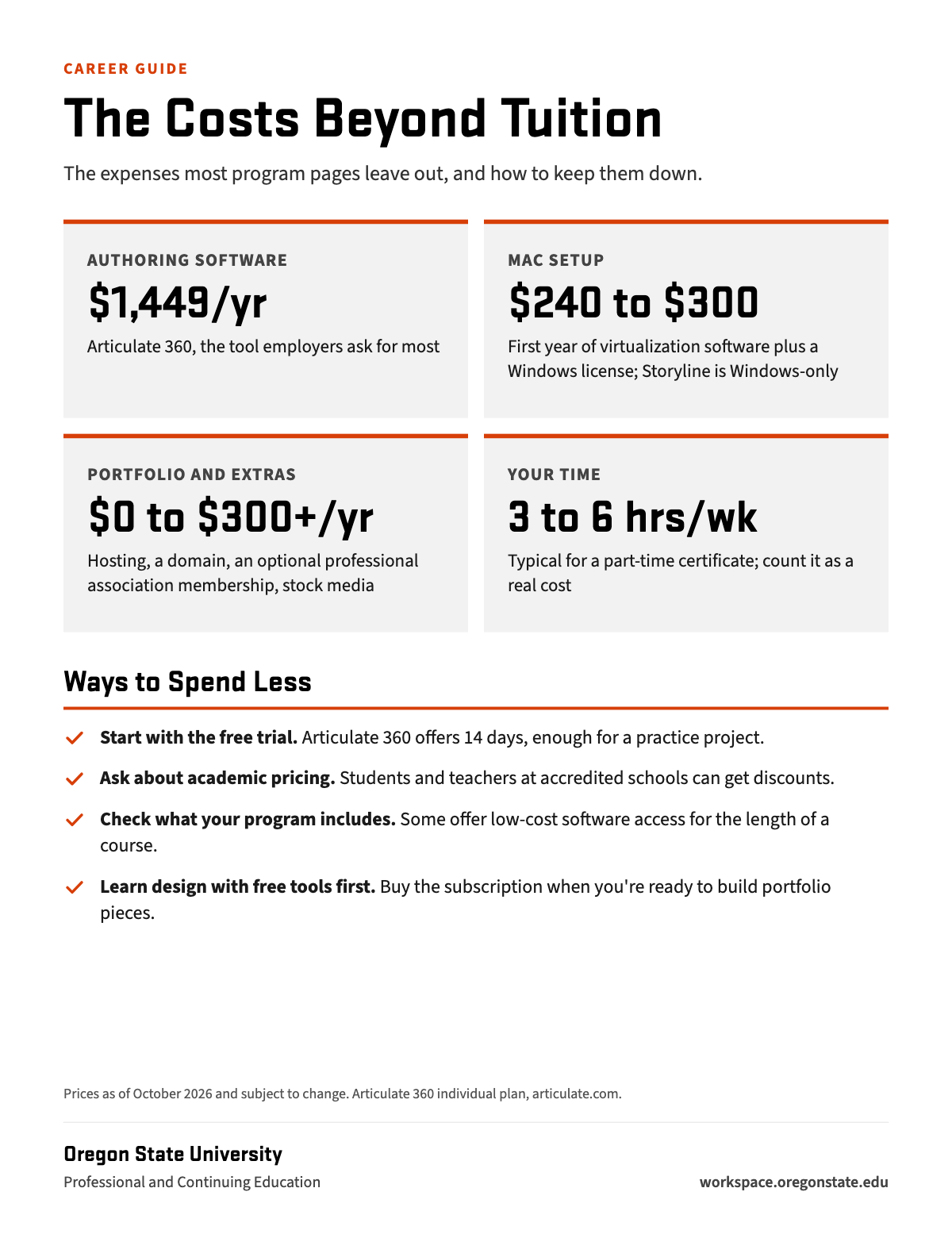
As of October 2026, Articulate 360 costs $1,449 a year for an individual and $1,749 a year per seat for teams. Some advanced AI features, such as translation and avatar video, use credits sold separately.
You may be able to lower the cost:
- Use the free trial for a practice project before you commit.
- Ask about academic pricing. Articulate offers discounts to students and teachers at accredited institutions.
- Check what your program provides. Some programs include course-length access. OSU offers enrolled learners Articulate 360 access for the length of a qualifying course for $75.
- Start with design, not software. Free tools are enough to learn analysis, objectives, assessment and evaluation. Buy the subscription when you're ready to build polished modules.
The Hidden Cost: Hardware
Articulate Storyline only runs on Windows. If you use a Mac, you'll need software that lets your Mac run Windows, plus a Windows license:
- Virtualization software: About $100 a year for Parallels Desktop's standard plan, with student discounts available.
- A Windows license: About $140 to $200, depending on the edition your Mac needs.
That adds up to about $240 to $300 in the first year. Another option is Articulate Rise, which runs in a web browser and works on a Mac without those extra purchases.
Other Costs to Budget For

- Portfolio hosting: Free website builders work fine. A custom domain usually costs a small yearly fee.
- Professional association membership (optional): National membership typically runs from about $130 for students to $300 or more a year, with local chapters often cheaper.
- Stock images, audio and AI credits: Free libraries cover most needs, but premium assets add up.
- Your time: Part-time certificates usually ask 3 to 6 hours a week. Count that time as a real cost, especially if you're working full time.
Your True-Cost Worksheet
Use this worksheet to compare the costs of two options you're considering.
| Cost | Path 1: ________ | Path 2: ________ |
|---|---|---|
| Tuition and fees | $ | $ |
| Software (after discounts or included access) | $ | $ |
| Hardware (Mac setup, if needed) | $ | $ |
| Portfolio hosting and domain | $ | $ |
| Memberships and extras | $ | $ |
| Total dollars | $ | $ |
| Hours per week × number of weeks | ___ × ___ | ___ × ___ |
| Feedback on your work? Credential? Portfolio project? | Y / N | Y / N |
What Oregon State's Certificate Costs
Here's what you'll likely pay for OSU's E-Learning Instructional Design and Development Certificate adds up:
- Tuition: $2,395 for all five courses, plus a $70 registration fee, or $479 per course if you take one at a time. That's 126 hours of instruction, under $20 an hour, and about half the tuition of other comprehensive university certificates we reviewed.
- Software: None to buy for the first four courses, which use free web tools. For the practicum, use any tool you have; if you choose Articulate, course-length access is $75.
- Hardware: Any computer with a web browser works for the certificate courses, Mac included.
- Time: Five six-week courses at about 3 to 6 hours a week, roughly eight months in a cohort.
- What's included: Feedback from experienced instructors, a practicum project for your portfolio, 12.6 CEUs, and six units you can later apply toward a partner online master's in learning design and technology.
You don't need to apply. You can start with one course or try the free Pathways to Instructional Design course first.
Frequently Asked Questions

Can I become an instructional designer for free?
Yes. You can use free courses, tools, and software trials. The trade-off is that you'll need to plan your own learning, find feedback, and create your portfolio independently. Some learners use free resources and pay for just one course or program.
Do I have to buy Articulate Storyline?
No. Start by learning design with free tools, then use a trial to practice. Because employers often ask for Storyline experience, make sure you can access it before creating your main portfolio samples.
Can I use Storyline on a Mac?
Not directly. Storyline runs on Windows, so Mac users need software to run Windows and a Windows license. Articulate Rise is browser-based and works on either Mac or PC.
Why do university certificates cost so much more than online courses?
The higher price often covers instructor feedback, a planned series of courses, a portfolio project, and a university credential. Prices vary: comprehensive university certificates can cost $4,800 or more, while OSU's certificate costs $2,395 plus a registration fee.
Can a certificate count toward a master's degree later?
Some certificates offer credit that can count toward a degree. OSU's certificate includes six units you can apply toward a partner online master's in learning design and technology, allowing you to start with a certificate and continue toward a degree later. See how the path works.