


From Access Barrier to Workforce Engine
When the CHW program at Oregon State University was first conceived, it was not built to generate revenue, expand course portfolios, or experiment with delivery formats.
It was built to solve a workforce problem.
Solving for Both - Industry and Learners

Healthcare leaders in Eastern Oregon were facing a growing shortage of certified Community Health Workers, or CHWs.
Community Health Workers serve as trusted community members who help individuals navigate health and social services, provide education, and coordinate care.
Through regional needs assessments and community health improvement planning, partners such as the Eastern Oregon Coordinated Care Organization identified a widening gap between the number of trained professionals needed and the number available.
Communities required culturally competent, locally rooted health workers.
But the training pipeline was thin.
Worse, access to certification training was structurally misaligned with the communities it aimed to serve.
At the time, the only available CHW certification program required learners to travel to Portland for six consecutive weeks of in-person instruction.
For many rural and working professionals, that requirement was not just inconvenient. It was prohibitive.
Participants had to:
-
Leave their jobs.
-
Step away from family responsibilities.
-
Travel long distances.
-
Absorb lodging costs.
-
Rearrange childcare.
For some, participation meant temporarily disconnecting from the very communities they were training to support.
The result was predictable.
The people most needed in the workforce pipeline were often the least able to access the training.
Faculty leaders within Oregon State’s College of Health recognized that solving the workforce shortage required more than curriculum. It required rethinking delivery, access, and sustainability from the ground up.
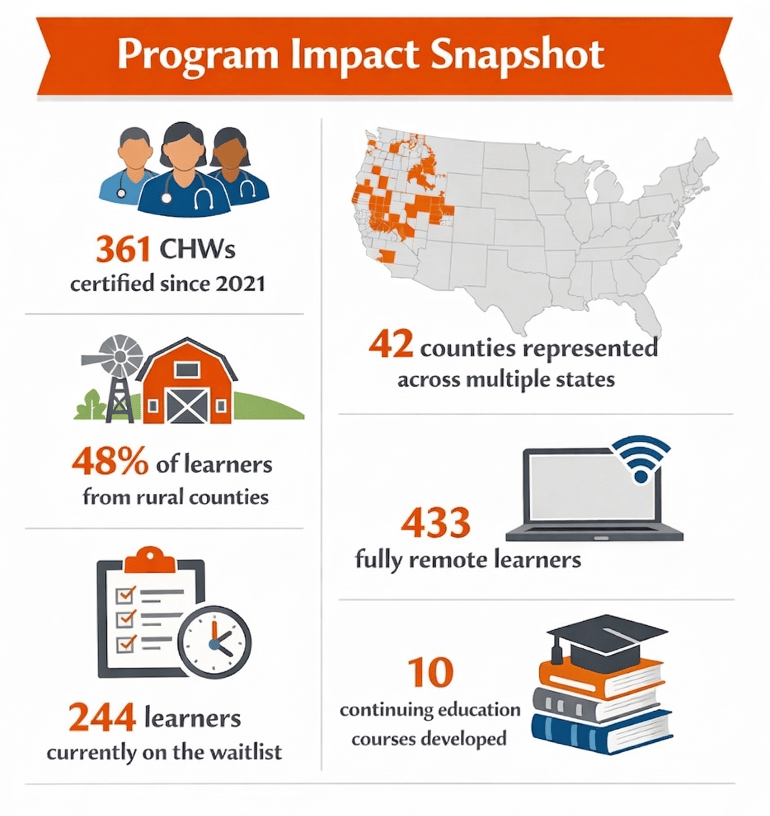
As of early 2026, the remote and hybrid training model, the program has trained more than 360 Community Health Workers, dramatically expanding the workforce pipeline serving Oregon communities.
The Structural Challenge Beneath the Surface

The early barriers facing the CHW program existed on multiple levels.
First were geographic realities.
Eastern Oregon spans vast rural distances. Travel time alone made centralized training difficult to scale. Even motivated learners struggled to justify weeks away from home and work.
Second were delivery limitations.
Traditional in-person training models require significant coordination, facility scheduling, and instructor availability. Scaling that model regionally would require major investment.
Third was financial fragility.
Initial development funding from regional healthcare partners made the program possible.
But like many grant-supported initiatives, long-term sustainability remained uncertain. Without an ongoing revenue model, the program risked becoming episodic rather than continuous.
If these challenges remained unresolved, the consequences were clear...
-
Workforce shortages would persist.
-
Training offerings could pause between funding cycles.
-
Communities would remain underserved.
-
Faculty capacity would be stretched thin.
The program needed a way to expand access while also stabilizing operations.
Building a Delivery Model That Met Learners Where They Are

To address these dual challenges, CHW faculty partnered with Oregon State University Professional and Continuing Education.
The collaboration centered on a simple but transformative question.
How do you expand access without expanding burden?
The PACE team supported the development of the blended training model that combined in-person instruction, online coursework, and virtual learning environments.
This hybrid structure solved a lot of the constraints:
-
Preserved the rigor required for quality training, while dramatically reducing travel demands.
-
Learners could complete large portions of training remotely.
-
Live virtual sessions supplemented asynchronous coursework.
-
Required in-person components were streamlined.
The model did not eliminate human connection.
It redistributed it.
Since Winter 2021, more than 430 learners have participated fully remotely across 21 course offerings, demonstrating the demand for flexible training formats that allow working professionals to learn without relocating or leaving their communities.
Faculty even became early adopters of virtual instruction platforms.
Long before Zoom became ubiquitous, the CHW training team was experimenting with synchronous online engagement, navigating early interfaces that were far less polished than today’s tools.
The shift was both logistical and philosophical.
Training was no longer bound to geography.
Today the program draws learners from 42 counties across multiple states, including Oregon, Washington, Idaho, California, and Georgia.
Nearly half of all participants come from rural counties, reflecting the program’s success in reaching communities historically underserved by traditional training models
Revenue Share as Operational Infrastructure

While delivery innovation expanded access, another component of the PACE partnership addressed sustainability.
PACE’s revenue share model created a funding stream that could be reinvested directly into program operations.
Program revenue has grown steadily as the training expanded.
Annual revenue increased from $73,800 in FY22 to more than $136,000 in FY25, supporting instructional staffing and ongoing program development.
One of the most immediate impacts was staffing.
Revenue share funding supported the addition of a part-time instructor. This single change significantly increased delivery capacity.
It also provided operational continuity during periods when primary faculty were on leave or balancing competing responsibilities.
-
Trainings could run on schedule.
-
Learners did not face cancellations or gaps.
-
Faculty could plan calendars with confidence rather than uncertainty.
Over time, the stability created by revenue share funding allowed the program to shift from reactive scheduling to proactive planning.
It was no longer a question of whether the training could run. It was a matter of how much it could grow.
A Pandemic Pivot That Became a Growth Catalyst

When the COVID-19 pandemic disrupted in-person education, many workforce training programs paused operations while attempting to reconfigure delivery models.
The OSU CHW hybrid program was positioned differently.
Because its hybrid infrastructure was already established, the transition to fully remote delivery happened quickly. Instructional workflows, virtual facilitation skills, and learner support systems were already in place.
At one point during the pandemic, the program became the only CHW training in Oregon able to continue operating without interruption.
This created an unexpected growth opportunity.
Enrollment expanded beyond Eastern Oregon.
Learners from across the state began participating. Healthcare organizations sought training solutions for their staff. Word-of-mouth referrals increased.
What began as a regional workforce response evolved into a statewide training resource.
The infrastructure built for access resilience became a competitive advantage.
Expanding the Portfolio Through Continuing Education

With foundational training stabilized and demand increasing, the partnership turned toward program expansion.
Continuing education emerged as a strategic growth lever.
To date, the program has:
-
Developed 10 continuing education courses
-
Generated more than 360 continuing education enrollments since launch
Working with PACE, faculty developed a portfolio of CE offerings designed to meet recertification requirements for Community Health Workers and other public health professionals.
Many courses were structured as self-paced modules, allowing learners to engage on flexible schedules while minimizing live instructor hours.
This format created several benefits:
-
It generated ongoing revenue.
-
It expanded the program’s reach.
-
It lowered delivery costs.
-
It made professional development more accessible for working health professionals.
Because the CHW program was already recognized as an approved foundational training provider through the Oregon Health Authority, newly developed CE courses also benefited from streamlined approval processes.
This reduced administrative friction and made it easier to collaborate with external partners interested in co-developing specialized training.
Demand Signals That Confirmed Program Momentum

As delivery models matured and CE offerings expanded, demand followed.
As of the most recent enrollment cycle, the waitlist includes more than 240 prospective learners, highlighting continued demand for the training across the region.
Organizational enrollments continue to grow. Faculty leaders are actively exploring the addition of further instructional staff to meet capacity needs.
Several key indicators reflect the scale of growth.
- Statewide enrollment reach
- Organizational bulk registrations
- Expanding course portfolio
- Sustained training schedules
- Reduced grant reliance
Courses are delivered in cohort-based formats designed to support discussion and peer learning. A typical cohort includes approximately 24 students supported by two instructors, maintaining strong engagement while allowing the program to scale.
Financially, the program has moved toward a largely self-sustaining model.
Revenue streams now support ongoing delivery costs and operational planning.
What began as grant-seeded workforce training has evolved into a revenue-supported education ecosystem.
Partnership Momentum Across the Health Sector

Success attracted attention beyond individual learners.
External interest continues to grow.
The program receives two to four new partnership inquiries each year, while agencies regularly enroll employees using workforce development funding.
In recent years, between 15 and 40 professionals annually have enrolled through employer-supported workforce funds.
Organizations across the health and human services landscape began approaching the program to develop collaborative training initiatives.
Partnership inquiries have included groups focused on:
- Palliative Care
- Mental and Behavioral Health
- Management of Chronic Health Conditions
- Supporting Families - Navigating Care and Services for Children with Special Health Needs
- Poverty and Related Social Determinants of Health
- EOCCO Community & Traditional Health Worker Continuing Education
These collaborations leverage the program’s instructional design support, certification alignment, and delivery infrastructure.
Some courses are fully self-paced. Others incorporate facilitated discussions or cohort-based learning.
The model is adaptable. And that flexibility has made it appealing to a growing network of public health partners.
Reinvesting Growth Into Faculty and Community Impact

Revenue generated through program expansion has not remained siloed within operations.
Funds have been reinvested to support broader academic and professional initiatives.
Examples include:
- Instructor stipends
- Subject matter expert engagement
- Conference participation
- Community outreach sponsorships
This reinvestment strengthens both instructional quality and professional engagement across Oregon’s health workforce landscape.
Growth has created a feedback loop. Expanded offerings generate revenue. Revenue supports faculty. Faculty capacity supports further expansion.
Stories That Illustrate Community-Level Impact

Beyond enrollment and revenue metrics, the program’s impact is most visible through learner outcomes.
One participant from a coastal Oregon community completed a course assignment focused on designing a local health intervention.
They developed a food access initiative during the pandemic, addressing supply disruptions affecting vulnerable populations.
-
The project moved beyond coursework.
-
It was implemented locally.
-
It reached community members in need.
-
It gained traction with regional partners.
The participant eventually advanced professionally and now manages the program they helped create.
Stories like this illustrate the multiplier effect of workforce education.
Training does not end at certification. It translates into community action. For many learners, the impact extends beyond workforce training.
Faculty have observed several graduates go on to pursue bachelor’s or master’s degrees after completing the CHW program, using the experience as a low-risk entry point into higher education.
What Happens Without the Partnership

Program leaders are candid when reflecting on what growth would have looked like without the PACE partnership.
Without revenue share support, adding instructional staff would have been difficult.
-
Trainings may have paused between terms.
-
Waitlists would grow without relief.
-
Continuing education expansion would likely stall.
Partnership development requires time. Without operational support, faculty bandwidth would have been consumed by delivery logistics rather than strategic growth.
Course pricing may have remained higher. Accessibility initiatives could have slowed. Community partnerships may not have materialized at the same scale.
In short, the program would likely still exist. But its reach and resilience would be significantly constrained.
Looking Forward: Expanding Language Access

Future growth priorities center on accessibility and equity.
Program leaders are exploring the expansion of Spanish-language continuing education offerings, as well as the possibility of foundational CHW training delivered fully in Spanish.
These initiatives aim to better serve Indigenous and Latin American communities across Oregon.
While some developments may require external grant funding, the partnership infrastructure is already in place to support design, delivery, and scaling once resources align.
A Replicable Model for Faculty Partnership

For faculty and academic units exploring collaboration with Professional and Continuing Education, the CHW program offers a working blueprint.
Partnership can provide:
- Marketing amplification
- Enrollment pipeline development
- Revenue generation models
- Instructional design support
- Flexible delivery formats
- Workload scalability
- External partnership pathways
The collaboration allows faculty to expand reach without proportionally expanding burden. Or, as one program leader summarized:
The partnership provides resources and operational support that allow programs to grow sustainably while still meeting learner and community needs.
From Regional Response to Statewide Resource

The Community Health Worker Training Program began as a targeted response to a regional workforce shortage.
Today, it operates as a statewide training ecosystem supported by hybrid delivery, continuing education expansion, and partnership-driven growth.
Its evolution reflects more than program success. It demonstrates what becomes possible when faculty expertise is paired with scalable infrastructure.
Access expands. Sustainability strengthens. Communities benefit.
And the workforce pipeline grows stronger as a result.